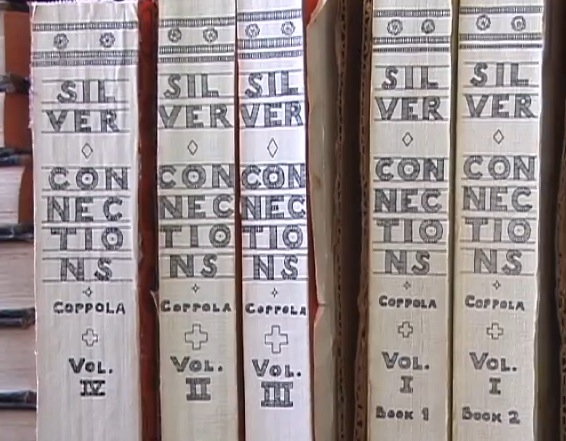
Silver Connections
A Fresh Perspective on the New York Area Subway Systems
by Philip Ashforth Coppola (The Four Oceans Press)
In 1978, Phillip Ashforth Coppola intended to spend a month working on an article about the art in New York City subway stations that he hoped to sell to a magazine. Today, forty years later, Coppola has probably not spent a day during which he did not work on this “article,” now a multi-volume collection of books, some self-published in limited edition and some in manuscript form.
David Dunlap in The New York Times:
Each “Silver Connections” volume has hundreds of 8 ½-by-11-inch pages, bound in card stock with thermographed cover artwork. Station by station, readers are taken through the system in order of the contracts under which they were built.
Besides his typewritten narrative — earnest, exhaustive art history that can drift off into whimsical flights of fancy — Mr. Coppola has produced hundreds of black-and-white line drawings of the stations’ ornamentation. Many take up an entire page. His hand-printed marginal notes describe the colors.
Silver Connections Volume I (Books 1 & 2) REVISED
Book I 430 pages, including bibliography
Book II 460 pages, including bibliography
Silver Connections, Volume I, celebrates the construction of New York’s very first subway line; it tells the story from the City Hall celebrations – with fireworks – when they commenced the project in 1900, through the years of trench digging and dynamiting and tunneling, to the October day in 1904 when the route opened to the public, and Mayor McClellan drove the first subway train careening around the curves of the brand-new tunnels until he surrendered the silver controller (a Tiffany special!) at last at 103rd Street. There’s an account of the advertising war (the ads won), and meanwhile a look at the subway pioneer All Stars – Contractor J.B. McDonald, Chief Engineer Parsons, the architect C. Grant LaFarge, and August Belmont II, of Belmont Park racetrack fame, who financed and ran the IRT. And also a look at the superb artisans who translated LaFarge’s plans into our excellent subway icons: the Astor beaver, Fulton’s steamboat, the Columbia University Seal, & the eagles at Brooklyn Bridge (forever hidden!?), 14th Street (recently recovered!), and 33rd Street. And much Much MORE!!!
Silver Connections Volume II
448 pages, 8 1/2 x 11
includes appendices, bibliography, & index
Limited Edition, 100 copies
To my knowledge, limited as it may be, there has not been a chronicle of the Brooklyn transit like this Volume II prior to its release in 1990. Within its pages there are the aforementioned horse cars, trolleys, and elevated lines, and the characters (figuratively and literally) who made it all happen. The lines examined are the Broadway El, the Myrtle Avenue remnant, the Franklin Avenue Incline, and the Canarsie line from Broadway Junction. These are all the existing transit lines prior to the BRT’s entry into the subway game. I planned my history to stop just short of Brooklyn’s subway system. Besides the evolutionary history, the last chapter recounts the diminution of the Brooklyn elevated system; listing each segment of the lines as they disappeared, chronologically, plus the forces which did the demolition work. The coming, and passing, of the Brooklyn Bridge’s transit amenities is also revealed. Some people don’t know that the bridge ever actually had trains running across it. And, as extras, the Williamsburg Bridge’s structural woes, at that time, are examined, and a visit to the mythical Atlantic Avenue Tunnel is recounted.
Silver Connections Vol III
Volume III covers the IRT stations (1905-1908) in The Bronx; No. 1 train up Broadway to Van Cortlandt Park, and the No. 2 & 5 train route along 149th St., Westchester Ave., Southern Blvd., & Boston Rd. to West Farms/East Tremont Ave. & Bronx Park. Some Bronx history noted; construction progress related. And also : The IRT stations (1908) in Brooklyn; No.’s 4 & 5 trains along Fulton St. & then Flatbush Ave. to Atlantic Avenue. Construction related.
Silver Connections Vol IV
Volume IV recounts the history of the Hudson & Manhattan RR, 1900-1962, and the Port Authority take-over, creating the PATH system, 1962-1998. History of Wm. G. McAdoo, company organization & system’s construction, the P.A. take-over, and progress since then, including 1993 terrorist bombing of World Trade Center.
Silver Connections
DUAL CONTRACTS PORTFOLIO: IRT PELHAM BAY LINE
168 pages, illustrated throughout, bibliography
This is the first volume of Coppola’s Portfolio Series, entitled DUAL CONTRACTS PORTFOLIO:IRT PELHAM BAY LINE. His first professionally printed book, this handsome 8×10 volume with full-color cover is 168 pages with numerous illustrations and a bibliography. When the series is completed, each portfolio of the series will detail one line of the subway system.
For information or to place an order contact Philip Ashforth Coppola at philoceans@gmail.com
 Philip Ashforth Coppola